
Nice Aunties
Remembering nice aunties, blunt aunties, and aunties that tell it how it is

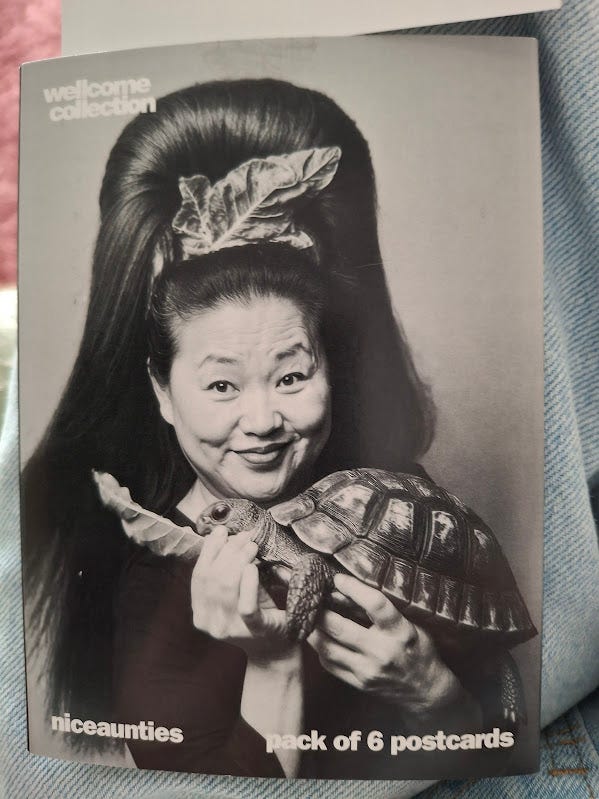
The best bit of the Coming of Age exhibition at the Wellcome Collection are the portraits of nice aunties by the Singaporean artist Wenhui Lim, known as Niceaunties. I bought a pack of postcards of nice aunties, and have been sending them out to older women of my acquaintance. It took me back to my childhood when adult women, not blood aunties, were called ‘Auntie’, a sign of respect, and a mark of closeness to the family, aka ‘friends of the family’. Rarely was a male friend of the family called ‘Uncle’. More often, the men were known by their full names: John Conlon, Sean Connolly, Brian Taylor, Tom Sullivan. The women were Auntie something, Miss something, or Mrs. something.
Much older men in the neighbourhood were known as Mr. Willard or Mr. Russell and so on. I don’t think my parents even knew their first names.
The closest aunties were Auntie Pam and Auntie Joan. Although we called Pam’s husband Dave Tutte, Auntie Joan’s husband was Uncle Jack. At Auntie Joan’s funeral, her wedding photo was on display, which showed my father, who had been best man. Dad and Jack were friends from before Dad even met my mum. In fact, Joan and Jack’s daughter, Karan, showed me the woman in the photo who my dad was going out with at the time, Karan’s aunt. ‘We could have been cousins,’ she said. ‘I’ve always thought of you as a cousin anyway,’ I said.
Dad and Jack were both Irish, Dad from Cork and Jack from Sligo. Uncle Jack had so broad an accent that few could understand him. Having known him all my life, I tuned in easily. By the time my daughters knew him, they could only make out ‘Chelsea for the cup’ when he spoke to them. Auntie Joan became a close friend of Mum, and for most of their lives they lived within walking distance of one another. Joan’s daughter Karan was my childhood best friend. Her son John was my brother John’s best friend, always referred to by their full names, John McCarthy or John Regan, to differentiate them.
Mum and Auntie Joan were Irish, too. Mum from Clare, Joan from Kerry. When I say they were best friends, they were also worst enemies, at times. Mum thought Joan considered herself a cut above. Joan could be blunt in her comments, in her criticism. The night before my first wedding, I had an attack of nerves and started crying at the small gathering my mother had arranged in her kitchen, a gathering I hadn’t wanted. Joan scooped me up and took me round to her house along with Karan. ‘Do you want to get married?’ she asked, the only one who voiced the doubts I’d kept inside my head until then.
‘I want to be married, I just don’t want all this fuss.’ The wedding had got out of control, the kind of occasion my mother would have wanted for her own wedding, and it no longer seemed to have anything to do with the bride and groom. Auntie Joan gave me a way out, should I choose to take it. Mum was furious with her for taking me away from the house. I shouldn’t think Mum ever voiced that to Joan herself; it was me that received the anger.
A few years later, I phoned Joan to tell her of the birth of my second child. ‘What did you have?’ I told her I had another girl. ‘Never mind.’ As I said, blunt in her comments. Even at Joan’s funeral, Karan told me that her mum had recently advised her to wear black at a special occasion. ‘It will slim you down,’ she said.
Both our mothers could be difficult in different ways. My mother never, ever cuddled any of us, and rarely spoke to us kindly. I once saw Karan sitting on her mum’s knee, Joan cuddling her. It looked strange to me, something I’d never experienced. My siblings and I were not shown love as children. And when I challenged my mother about that as an adult, she reluctantly ended every phone conversation thereafter with ‘Maria, I love you,’ as if they were the most difficult words she’d ever spoken, and I never believed they were heartfelt.
At Joan’s funeral, I started crying when Karan showed me the wedding photo with my father as best man. I told her I’d gone in search of my dad’s story, to discover how the boy he once was became the man he ended up as; a drinker, a gambler, unable to love his children. Karan placed her hand on mine. ‘I know what it was like for you,’ she said. ‘My mum could be difficult, but I know that I was loved.’
Joan and my mother were in contact daily in their later years. They walked their dogs together, spent time in one another’s houses, and when they each became too frail to visit the other, they spoke on the phone every day. My mother died six weeks after Joan. Whilst I felt the need to go to Auntie Joan’s funeral, I didn’t attend my mother’s.
I have only two nice aunties left, and I’m grateful for each of them. One is my father’s sister, Kathleen, who was born 15 years after him, and is now in her early 80s. Dad would have been 98 this July. I wasn’t that close to Auntie Kathleen as a child, mostly because my mum took against her and Uncle Jack. Mum told me things about Kathleen and her children’s preferential treatment by my grandparents, which turned out not to be true. I became close to Kathleen once I researched my dad’s childhood, and even more so after my big brother John’s sudden death, late in 2022.
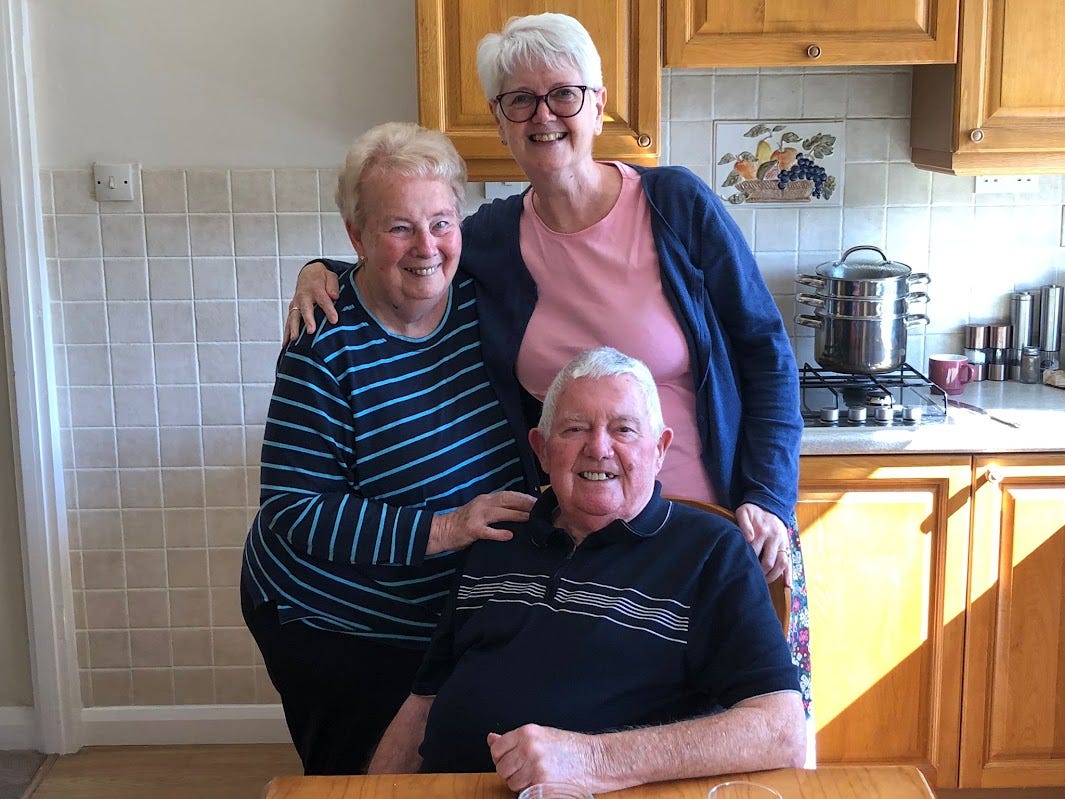
There is a remaining blood auntie on mum’s side, but we aren’t in touch. Instead, I came to know my Uncle Dickie’s second wife, Cosima, on a trip to Ireland in 2022, and we remain in contact from time to time. Cosima had been told lies about me by my mother, who had been dead for four years by the time Cosi and I first met. She chose to make her own opinion, and we got on fantastically at our first meeting. ‘I didn’t agree with your mother, what she said about you,’ Cosi said. ‘And I told her so.’ Two aunties that saw through the bullshit: Auntie Joan and Cosima, who told it as they saw it. I don’t call Cosima ‘Auntie’; as I only met her in my sixties, it didn’t seem right. The other aunties, Joan and Kathleen, will always be aunties to me.
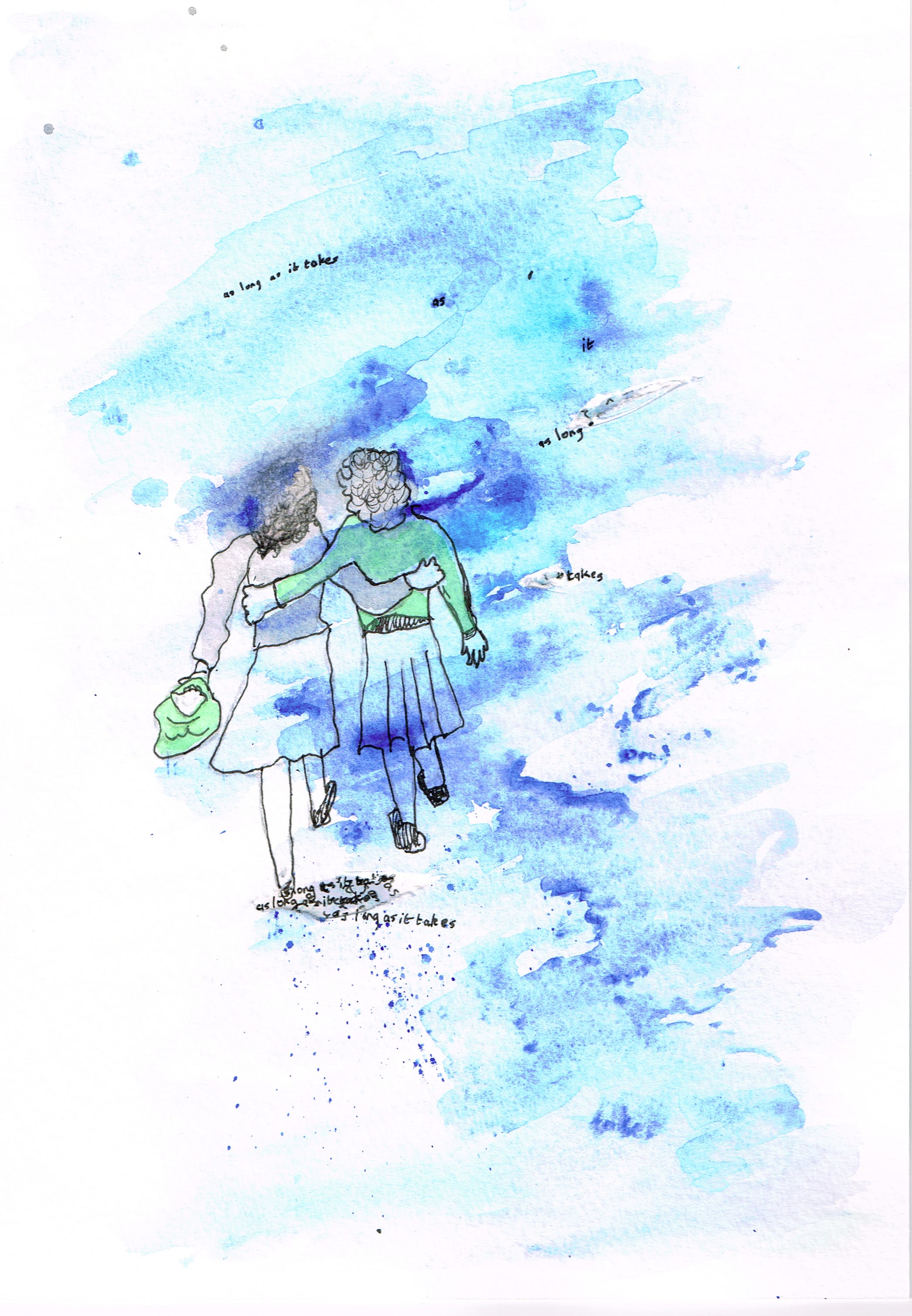
The house that Joan lived in, and her physical appearance, inspired the title story of my collection As Long as it Takes. In that story, a character called Joan, an Irish woman, suffers a late miscarriage, one of several. At Joan’s funeral, years after writing that story, I discovered that Joan had had similar problems. After the birth of her son John, she was advised not to try again for another baby. She did not take that advice, and went on to give birth to Karan. We know more than we think we know; perhaps I had overheard conversations as a child, not consciously remembered.
I have a few copies of As Long as it Takes, which can be ordered for £12 including p&p (UK orders only). Email me with your postal address and I can send a Paypal invoice: maria[at]medwaymaria.co.uk
‘Never mind’ - on having a baby girl! That is blunt!
Your trying to make sense of your dad (and your mum) in the context of their own histories is very touching. It’s a jigsaw never quite completed, I think.
I love a celebration of aunties. It takes a village of aunties to raise a child. Those postcards are lovely too.