
Learning to be Irish
Uncle Martin would teach me Irish rebel songs, singing a line, getting me to sing it back. ‘Now, don’t be singing those songs at school, or to your English friends,' he said.

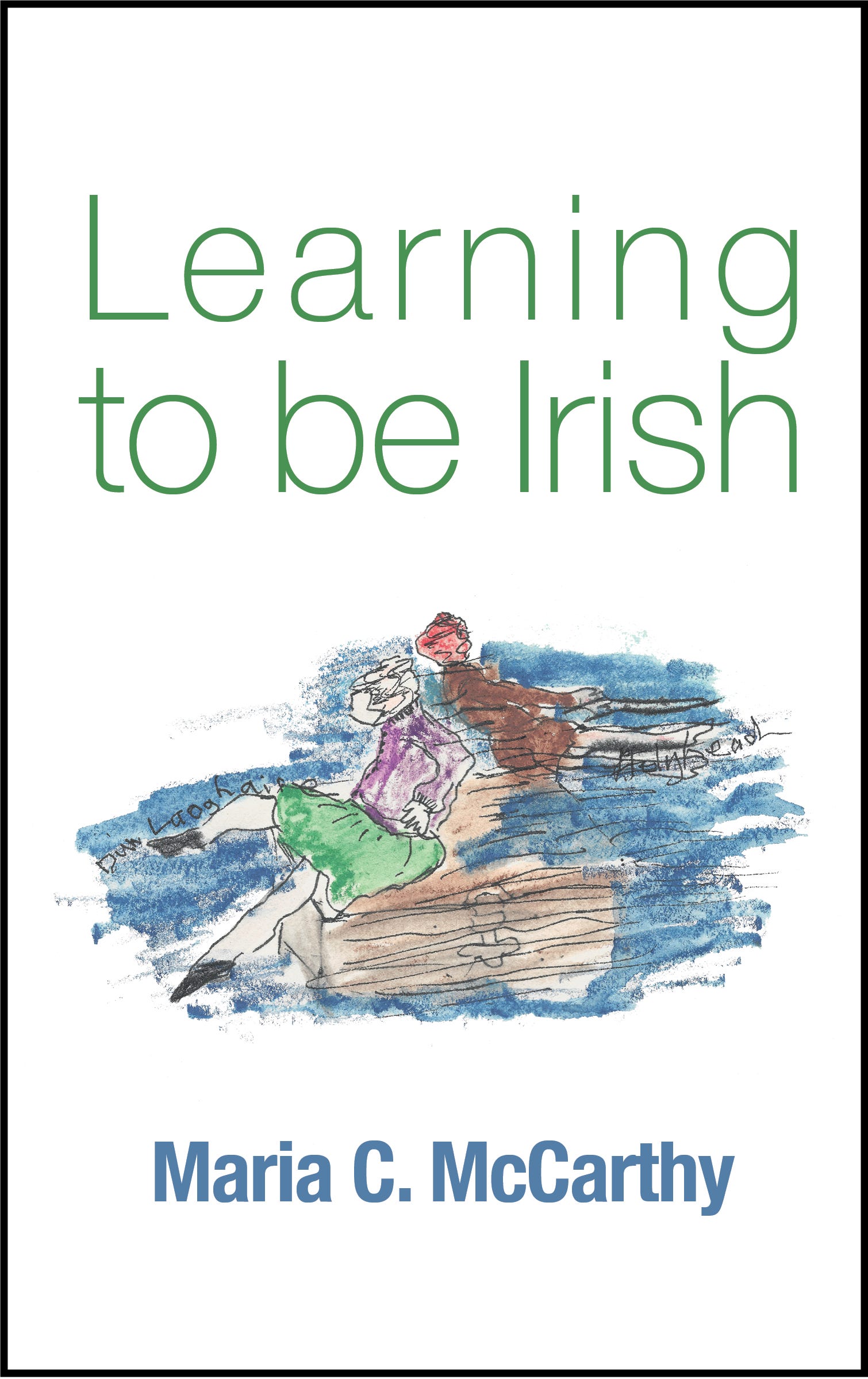
I’m Irish with an English voice,
English with an Irish heart,
floating forever between
Holyhead and Dun Laoghaire,
an Irish girl, an English woman,
not half and half: completely.
From my poem, ‘Completely’, in Learning to be Irish.
I believe that as a writer, as any kind of artist, you do not choose your material, it chooses you. You can push it aside for so long, but in the end you have to deal with it. When I started an MA in Creative Writing, nearly twenty years ago, I began with a story based on something my ex-mother-in-law had told me. When she showed me the family Bible with births, names and dates recorded in the front, she pointed out the name of someone who'd had a baby out of wedlock. My story was about that woman in her old age, imagining she was holding the baby that she had given up as a young woman.
I don't know if the story was any good. I probably have it in my box of MA course notes and assignments. But what became clear to me as I got further into the course was that I was avoiding writing what I needed to write. In writing about the English family I had married into and divorced out of, I wasn't writing what I really knew, or wanted and needed to know, about the Irish family I was born into. I began that work in the second term, in a module called Writing Prose Fiction. When I showed my tutor, Patricia Debney, a pair of linked short stories about an Irish mother and her English-born daughter, she wrote, ‘This has legs, and more than anything you need to discover where you have come from’.
I've been turning this material round ever since – in poetry, in fiction and in memoir – trying to make sense of it, to discover more about myself and my parents’ history. Even now I'm making new discoveries, coming to new realisations. The work is not finished. Will it ever be? Some of it is now bound in my new book, Learning to be Irish, published by Siglum. Now comes the work of selling it, promoting it, hoping that it will move readers, make them laugh, maybe shock them at times.
The writing of new material, as well as editing and compiling existing work, has come during a dramatic and traumatic period in my family of birth and in the family that I have made. In August 2022, an uncle’s violent death was all over the news; my older brother died suddenly and unexpectedly a few months later; soon after, my younger daughter was diagnosed with breast cancer; my husband suffered two heart attacks, a year apart; there was a long and painful dispute over my late brother’s estate, which highlighted the inter-generational trauma passed down to the McCarthy children, and led to estrangement. At times, I stopped writing, or wrote in fear, but I ploughed on. A writer friend, John O'Donoghue, suggested I was travelling through the Inferno, the circles of hell as described by Dante in The Divine Comedy. I bought a translation and charted my own progress through to Purgatorio and Paradiso.
I read and wrote in my new writing shed, acquired with funds from a commission to compile and edit a book, Inspired by Six Women who Shook the World. I am astonished and proud to have brought Inspired by… to publication with S.M. Jenkin and Bob Carling, and to have brought Learning to be Irish to fruition during such a turbulent period in my life. Will I ever reach Paradiso? Probably not, but thank God for the writing, which has saved my life many times and continues to keep me well.
I now offer a sneak preview of a chapter of Learning to be Irish. This extract is from a piece called ‘Learning to be English’. It started in a much shorter form as a radio broadcast on BBC Radio 4's Home Truths in 2006, and the transcript appeared in printed form in my self-published pamphlet, Learning to be English, in 2007. I was asked to read it at my friend Audrey Shilling's 80th birthday party. Migrants, first and second-generation, from other cultures than my Irish background came to talk to me afterwards to say how it had resonated with their own experiences.
From ‘Learning to be English’.
My parents met at a dance above the Gas Showrooms in Epsom in the mid-1950s. My father had come over to England from Mitchelstown, a small town in County Cork, in 1944; my mother from Ennistymon in County Clare in the early ’50s. They married at St Clement’s Roman Catholic Church in Ewell, my mother in a blue suit, five months gone, after falling pregnant with my brother John the first time she’d gone ‘all the way’ with my father on an autumn day on Epsom Common. She had the flu on their wedding day, and retreated from the reception early. Dad stayed on, drinking. He started as he meant to go on.
Mum and Dad stuck to their wedding vows until Death did them part 45 years on, despite not appearing to like each other, and went on to have four more children. I am in the middle, the filling in the sandwich, a sister and brother above me, a sister and brother below. Aged roughly two years apart, all five of us went to St Joseph’s RC Primary School. The school was a United Nations of Spanish, Italian, Polish and Irish children, the progeny of economic migrants, come to work in the seven hospitals that Epsom boasted at the time. These were the days when the people of London sent their troublesome relatives to the country, to asylums. Those with severe psychiatric illnesses (or ‘milk fever’, or other temporary disturbances that may have got better if they hadn’t remained locked away for the rest of their lives), and those with what we then called mental handicap. My mother worked in West Park Hospital, which we called a ‘mental hospital’ back then, as a Nursing Auxiliary, and many of my friends’ parents also had jobs in the hospitals.
My dad worked ‘on the buildings’, leaving in Uncle Bill’s van before the rest of the house had risen, labouring on sites as long as there was daylight. Long days in the summer months, sometimes returning home for dinner long after the rest of the family had eaten, his plate kept warm on top of a saucepan of hot water, an upturned plate over the meal, so it looked like a flying saucer. If he had money, he’d go to The White Horse with Uncle Bill and the other men he worked with, and come home long after the gravy had congealed on the plate, the meat shrivelled, the potatoes and vegetables dried up.
We lived in a house allocated by the council after the prefab where I was born was deemed overcrowded. I was four when we arrived at the new house, the youngest of us a few months old, and that’s where my parents lived out the rest of their lives, my brother John also ending his days there nearly 60 years after we all moved in. The small estate of post-war houses, pebble-dashed and painted white, all with the same front doors and windows, nestled in an outer circle with small roads branching in and out. There were few car owners and little traffic, and games of Red Rover, British Bulldog and ‘Please Mister Crocodile, may we cross your golden river in your golden boat?’ took place on the street, but not on the one green on the estate where the man lived who punctured footballs that fell into his garden.
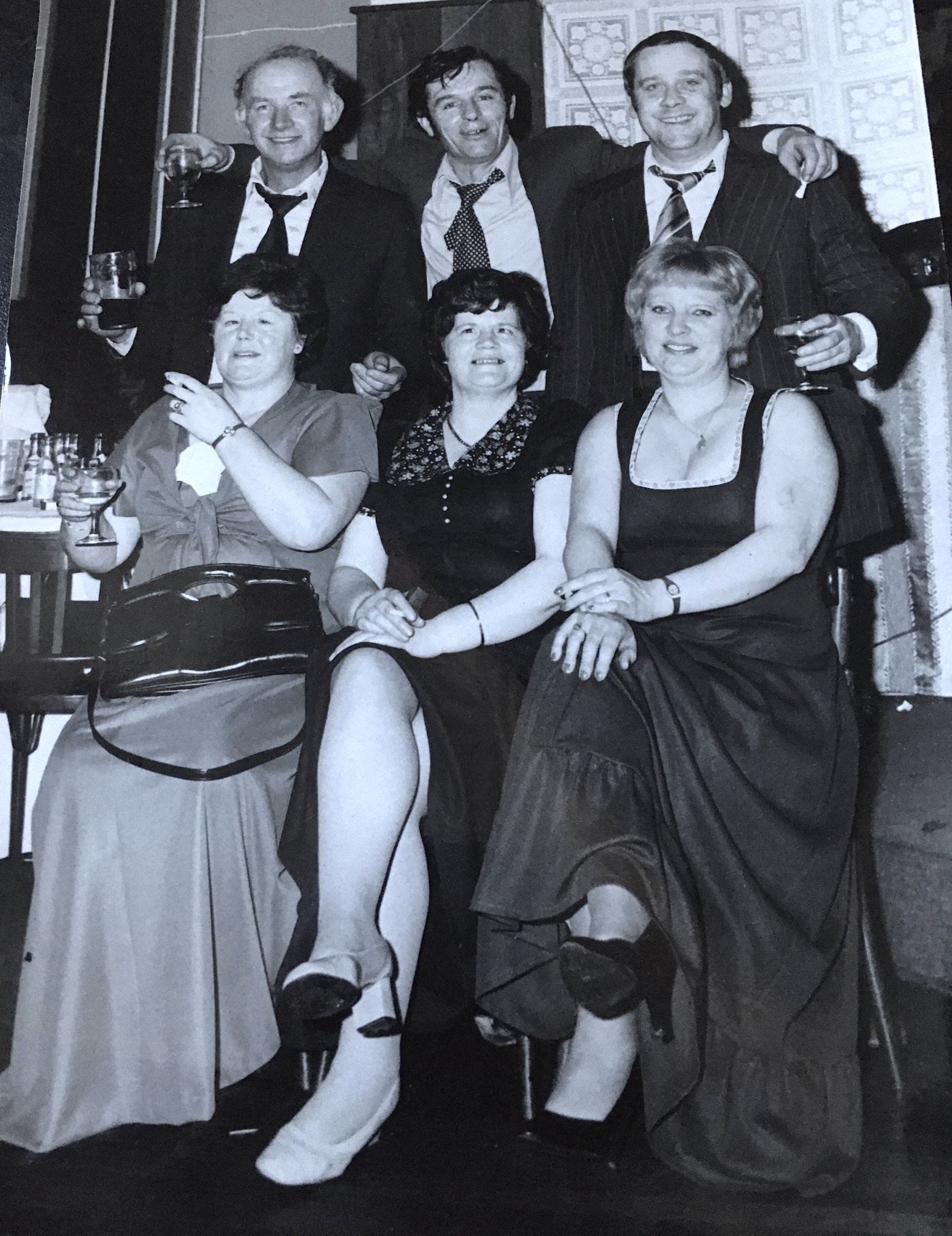
We lived amongst Sullivans, Corrigans, Regans and McLoughlins. We socialised with other Irish families at dances, weddings and parties. Coaches took us to the Irish dances at Surbiton Assembly Rooms, the women in long dresses, the men in suits, the girls in fancy dresses with new white socks, which would be black on the soles by the end of the night from sliding across the polished floor in the lobby. The women would gather with handbags on the tables, the ash growing on cigarette ends as they talked. The men stood at the bar, bringing Cinzano and lemonade for the women, Pepsi in glass bottles with straws for the children. Although many men joined in the set dances, to the music of an Irish showband, Dad and Uncle Bill were not amongst them, but Mum and her sister, Auntie Chris, were never short of partners. We children joined in, too, swept off our feet in the reels, dizzy as we were dropped back to the floor. I don’t remember getting home. I must have been lifted, asleep, onto the coach and carried from the end of the road to our house, undressed and put to bed without waking.
There were parties at home, too. My mother was the eldest of fourteen, and quite apart from the brothers that came over from Ireland and stayed while they found work and somewhere to live, there were uncles in Acton, Auntie Chris who lived near to us, and Auntie Bridget in Orpington. The Acton and Orpington contingents would arrive unannounced, with none of the families being on the phone, armed with loaves of bread, joints of meat and bags of potatoes and vegetables. Auntie Bridget bringing not only her six children, but anyone else on her road that might want to tag along, plus her husband Matt and his brother who wore a hat with a small feather in it, and whom we knew only as Fairy. Uncle Matt had a bald patch, until one day he hadn’t. He arrived one Sunday sporting an ill-matched toupee, and was thereafter referred to as Uncle Matt-on-his-head.
Sometimes the gatherings were Sunday lunchtime to early evening; other times the visitors would come on a Saturday and party into the night, with Irish records on the Dansette, singing and dancing. People would sleep wherever they found a space, only Chris and Bill returning home in the small hours. When Uncle Martin came from Acton, he would teach me Irish rebel songs as I sat on his knee, singing a line as he bounced me up and down, getting me to sing it back until the whole song stuck. ‘Now, don’t be singing those songs at school, or to your English friends,’ he told me. He was the only one of the uncles who didn’t drink alcohol, so he didn’t join the men at the White Horse for the Sunday lunchtime session. He and Auntie Marie didn’t have children, and Martin loved giving us treats. My parents didn’t drive; Martin drove a lorry for a living and owned a Mini. ‘Who wants to go for a spin?’ he’d ask, and as many of us as would fit piled into the car. He’d take us up to Epsom Downs, and try to scare us by taking his hands off the steering wheel for a few seconds. As we got older, if a work trip took him close to Epsom, he’d park the lorry outside our house and take a couple of us with him. Sitting high in the cab above the traffic, he’d put me in charge of navigating, a map laid across my lap. There would be stops at greasy spoon cafés for strong tea, toast and jam. Then we’d arrive at the drop-off and stay in the cab while the lorry was unloaded.
[ENDS]
To read on, order a copy of Learning to be Irish, available from the usual online outlets and I'm also taking direct orders via my website, UK orders only.
Authors and publishers only make a tiny amount from sales via Amazon and the like, so please support me and Siglum Publishing by ordering here, where many online outlets are also listed.
The launch of Learning to be Irish is on Saturday 19 July 2025, 1.00 – 2.30 p.m. at Sun Pier House, Chatham. There will be readings, live music with an Irish flavour, and books! Learning to be Irish will be at the discounted price of £10 at the launch (usual price: £11.99).
Congratulations Maria, I enjoyed this very much. Much familiar to me growing up in the north west.
Congratulations, Maria. Great opening. I will order a copy.
So pleased you did this while grappling with Dante!
Incidentally, I'm wondering how many of our parents met at dances? Mine did!